Why Private Equity Is Buying Marinas

The investment case behind private equity's institutionalisation of waterfront.
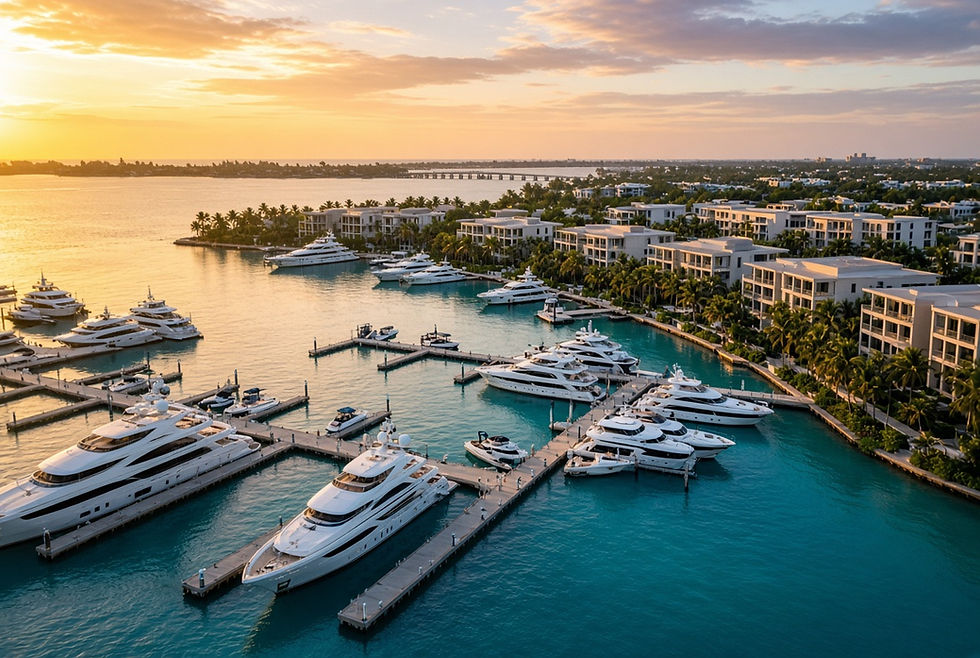
For most of my 25 years working across investment, finance and the maritime sector, marinas were regarded primarily as operating businesses. They were often family-owned, locally managed and deeply connected to the communities in which they operated. Their value was well understood by marina operators, yacht brokers, boatyards and waterfront developers, but the sector attracted little attention from major institutional investors.
That has changed. Over the past decade, private equity and infrastructure investors have moved steadily into the marina industry. What began with individual acquisitions and small portfolios has evolved into the creation of billion-dollar platforms.
The First Wave: Proving The Model
The initial attraction was relatively straightforward. The marina industry is highly fragmented. There are thousands of marinas around the world, but relatively few operators with meaningful scale. Many individual facilities remain independently owned, with limited access to institutional capital and considerable differences in management, technology, pricing and customer experience.
For private equity, that presents an obvious opportunity:
Acquire a strong initial platform
Add smaller businesses
Professionalise operations
Invest in the underlying assets
Improve revenues and margins
Build a recognised brand
Then ultimately sell a much larger and more valuable business.
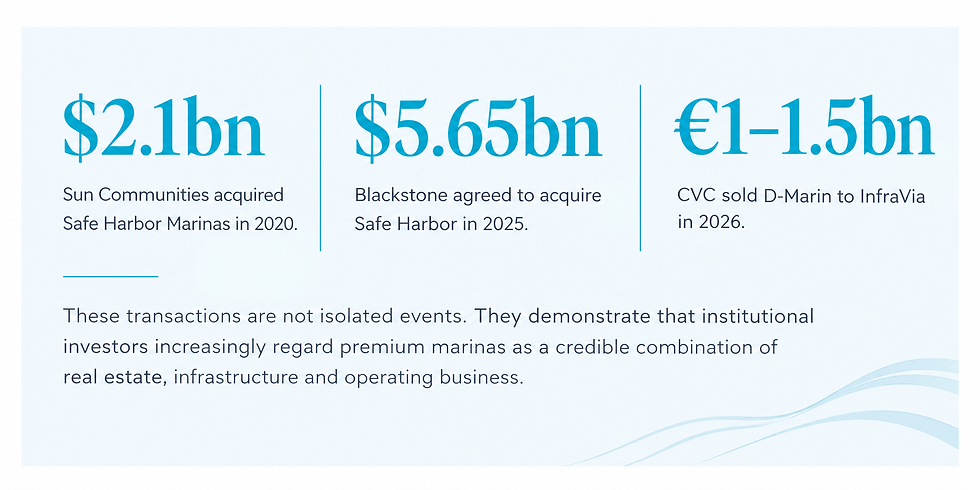
Safe Harbor became one of the clearest examples of this strategy in the United States. Institutional backing allowed the company to pursue an aggressive acquisition programme and build a substantial portfolio of marinas. By the time Sun Communities acquired the business in 2020, Safe Harbor had grown to 101 marinas and approximately 40,000 boat-owner members. The acquisition was important for the sector because it demonstrated that a collection of individual marinas could be assembled into an institutional-quality platform.
The $5.65 Billion Validation
The subsequent Blackstone transaction took that validation to another level. In 2025, Blackstone Infrastructure agreed to acquire Safe Harbor for approximately $5.65 billion. By then, the business had grown to 138 marinas across the United States and Puerto Rico.
The significance is not simply the headline valuation. It is what the valuation tells us about how institutional capital now views the sector. Blackstone’s investment thesis pointed towards several long-term fundamentals: population growth in coastal markets, increasing leisure expenditure and sustained demand for boating infrastructure. But underneath those themes is something even more important.
There is only so much prime waterfront.
You can build another hotel. You can build another apartment building. You can manufacture another yacht. Creating another premium marina in the right location is considerably harder. Planning restrictions, environmental regulation, dredging, navigation requirements, coastal constraints and community opposition all make new marina development difficult.
The existing marina therefore benefits from something investors understand extremely well:
scarcity.
Europe Takes The Premium Route
The European market has developed along a somewhat different path, with a greater emphasis on premium marinas, superyachts and destination locations. D-Marin is perhaps the best example. When CVC acquired D-Marin’s businesses in Greece, Croatia and the UAE in 2020, it explicitly described the investment as an opportunity to create a leading global premium marina operating company through acquisitions and organic growth. The strategy delivered.
D-Marin expanded across Europe and the Mediterranean and developed a consistent premium customer proposition. By 2026, the company had grown to 28 premium marinas across nine countries, more than 14,300 berths and more than 1,000 superyacht berths. CVC subsequently agreed the sale of D-Marin to InfraVia Capital Partners in a transaction reportedly worth between €1 billion and €1.5 billion.
Once again, the underlying lesson is clear. Institutional capital can take a fragmented collection of waterfront assets, create scale, professionalise the operation and ultimately create an asset that is attractive to another institutional investor. That is classic private-equity value creation.
So, Why Marinas?
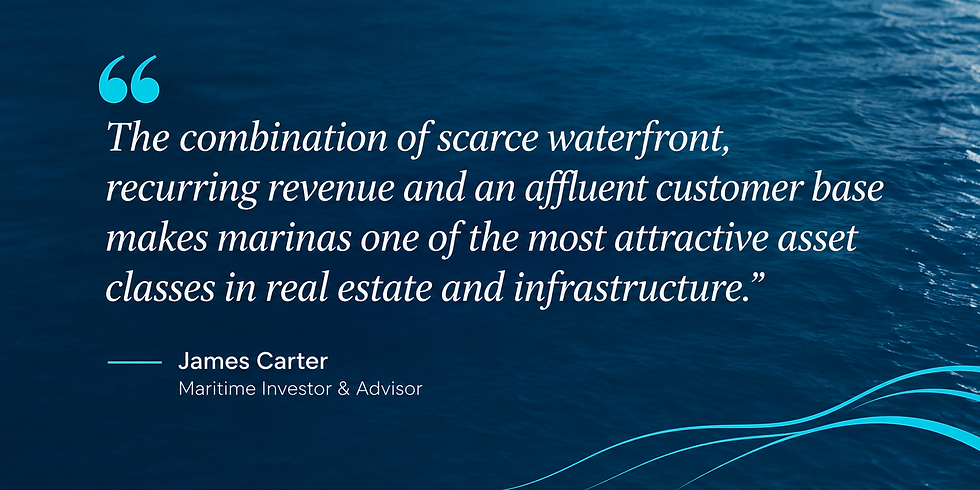
Scarce waterfront drives pricing power - Premium marinas offer access to limited protected waterfront in desirable locations. High barriers to new supply give established sites strong, hard-to-replicate pricing power.
Recurring revenue with upside - Stable income from berths, seasonal occupancy and storage is enhanced by fuel, maintenance, retail, hospitality and other services, creating predictable base revenue plus operating leverage.
Wealthy, resilient customer base - Customers store and maintain high-value yachts, producing a stronger economic relationship than typical leisure businesses. Larger, more sophisticated vessels further boost demand for premium services.
Fragmented industry enables consolidation - The sector remains fragmented relative to its value, offering private equity a clear path to acquire platforms and scale through multiple transactions.
Dual value creation through operations - Beyond real-estate appreciation, operators can improve utilisation, pricing, contracts, procurement, digital tools, dry-stack capacity and service revenues—delivering both asset and operating-company upside.
This blend of real-estate and operating-company upside makes the asset class highly attractive to institutional capital.
The Next Wave: From Marina to Waterfront Platform
The current investment cycle remains largely focused on acquiring existing marinas. Yet as valuations for established marina infrastructure continue to rise, a complementary opportunity is emerging: creating new forms of revenue-generating waterfront capacity rather than simply competing for the same assets.
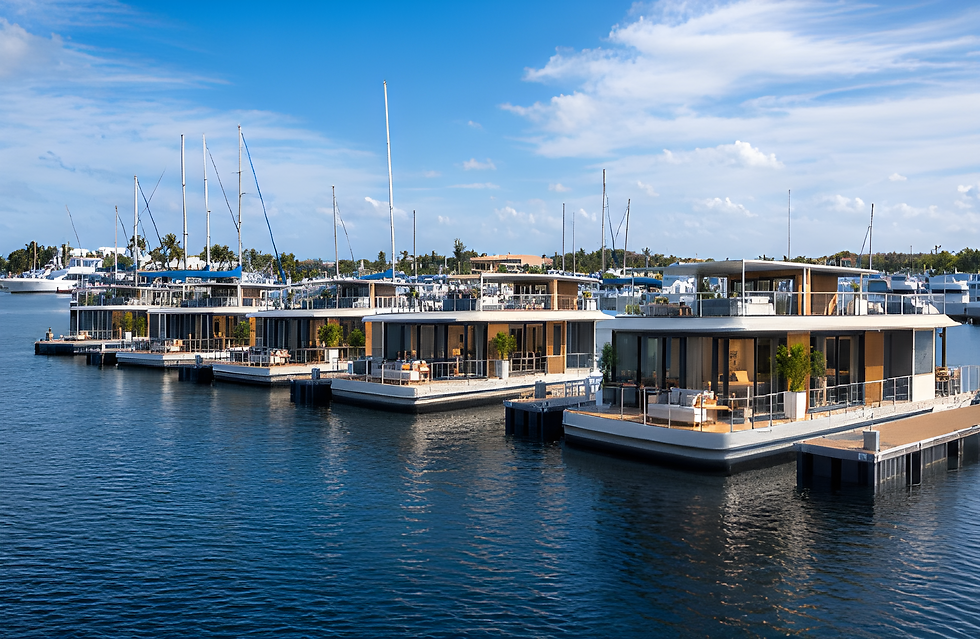
This shift highlights an important distinction between traditional marina development and broader waterfront development. The goal is not necessarily to build another conventional marina. It is to increase the economic output of an existing waterfront footprint. Floating accommodation offers a clear example. Well-designed floating suites can add premium lodging capacity without consuming additional conventional land, while complementing marina operations, expanding hospitality offerings and providing flexibility that fixed real estate cannot match.
At Nauti Marine we see this as the direction of travel. The future of waterfront hospitality will not be confined to the land. The marina of the future will function as an integrated waterfront platform where yacht berthing sits alongside storage, maintenance, restaurants, retail, accommodation, hospitality, events and experiences.
Each element reinforces the others:
The yacht owner becomes a hospitality customer
The hotel guest becomes a marina customer
The restaurant benefits from marina traffic
The marina benefits from the broader destination
The waterfront becomes an integrated commercial ecosystem
This model is especially compelling in locations where conventional land is scarce, expensive or difficult to develop. In these settings the true value of waterfront is not merely the land itself, but the access to the water and everything that can be built around that access.
Why the Trend Will Continue and What Happens Next
Institutional investment in marinas is set to continue for four fundamental reasons. Supply remains tightly constrained: there are only a finite number of genuinely strategic waterfront locations. Demand stays robust, supported by high-net-worth consumers, larger vessels and rising appetite for premium experiences. The industry is still fragmented, leaving substantial room for consolidation and professionalisation. And as more private equity and infrastructure capital enters the sector, liquidity increases, making exits easier and attracting further investment.
The result is a virtuous cycle. Capital enters, platforms consolidate, assets improve, revenues rise, valuations increase, larger institutions follow, and the cycle repeats.
Looking ahead, the next decade of marina investment is unlikely to be defined simply by owning more berths. The more interesting question is what can be built around them. The most valuable waterfront assets will increasingly function as integrated platforms—combining marina infrastructure, yacht services, hospitality, accommodation, leisure and experiences into a single ecosystem. For investors this creates a broader opportunity than traditional marina ownership: the chance to control the waterfront platform itself, which may ultimately prove more valuable than the marina alone.
The underlying thesis remains straightforward. Prime waterfront is scarce. The customer base is affluent. Revenue can be recurring. Supply is difficult to replicate. The industry is fragmented. And there is still considerable scope for professionalisation and consolidation.
Private equity has recognised these characteristics, and the current wave of transactions is the result. More capital will follow. Yet the biggest opportunities may not belong to those who simply acquire existing marinas. They are more likely to belong to those who understand how to create entirely new forms of value on the water. The question is no longer simply who owns the marina, it is who controls the waterfront ecosystem around it.
That is where the next chapter of the industry is likely to be written.


Comments